
Real use cases, honest limitations, and what’s actually working for Shopify merchants in 2025
‘Generative AI’ has become one of the most overused phrases in e-commerce. Every tool now claims to be ‘powered by generative AI’ especially with the rise of next generation AI commerce platforms‘.
This guide strips away the marketing and explains what generative AI actually does in the context of online retail where it creates real value, where it’s mostly hype, and what Shopify merchants are using it for right now.
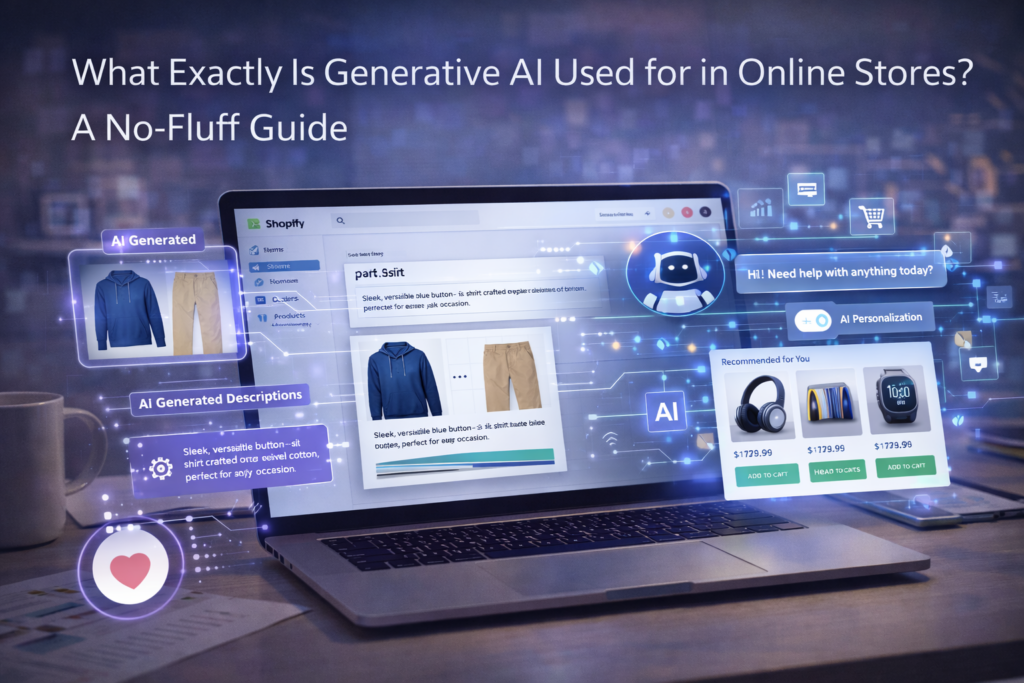
What Generative AI Is (Briefly)
Generative AI refers to AI systems that create new content text, images, audio, code based on patterns learned from training data.
The most familiar example is ChatGPT. Unlike traditional software that follows rules, generative AI generates responses, which means it can handle novel situations, write in different styles, and hold coherent conversations.
In e-commerce, this capability shows up in several concrete places:
Use Case 1: AI Generated Product Descriptions and Copy
This is the most widely adopted use of generative AI in e-commerce. Tools like Shopify Magic allow merchants to generate product descriptions, homepage copy, email subject lines, and ad creative from a product title and a few attributes.
What works: First drafts at scale. If you’re adding 200 products to your store, generating a baseline description for each with AI and then editing takes a fraction of the time of writing from scratch.
What doesn’t work: Unedited AI copy at scale. AI descriptions tend to follow predictable patterns (‘Introducing the X the perfect Y for Z’). If every product description follows the same AI formula, your store sounds generic. The best use is AI as a starting point, human editing for brand voice.
Use Case 2: AI Customer Support and Chatbots
Generative AI underpins modern customer support tools in e-commerce. Unlike rule based chatbots that could only respond to exact trigger phrases, generative AI chatbots understand natural language customers can ask questions in their own words and get relevant responses.
Gorgias’s AI Agent, Tidio’s Lyro, and others use large language models to understand intent and generate contextually appropriate replies, trained on your store’s specific product and policy information.
What works well: FAQ deflection, order status queries, return policy explanations, product compatibility questions.
What doesn’t work yet: Nuanced sales conversations. When a customer needs to be persuaded, not just informed, generative AI chat still underperforms human agents and, interestingly, conversational AI voice agents create trust and urgency that text chat cannot replicate
Use Case 3: Personalised Product Recommendations
Generative AI is being combined with recommendation engines to create more conversational discovery experiences.
Instead of showing a carousel of ‘you might also like’ products, AI can engage a customer in a product finding conversation: ‘What’s the occasion? What’s your budget? Do you prefer X or Y?’
Rep AI and similar tools offer this on site. AI driven phone experience does this over the phone where the conversational format drives higher engagement and conversion on considered purchases.
Use Case 4: AI Powered Search
Generative AI is transforming on site search from keyword matching to intent understanding. A customer who searches ‘something for a cold rainy day’ on a fashion site should surface waterproof jackets and wool sweaters not results that contain the word ‘cold’.
Shopify partnered with Liquid AI in November 2025 to deploy generative AI models specifically for product search and recommendations. Early testing showed higher conversion rates compared to Shopify’s previous search stack.
Use Case 5: AI Voice Agents for Sales and Support
This is the fastest growing generative AI application in e-commerce and the least discussed. Generative AI makes voice agents sound and respond like humans, handling conversations that traditional IVR systems and rule based bots could never manage.
Consio’s AI voice agent uses generative AI to:
- Answer inbound calls with full Shopify context (order history, cart contents, product details) in real time
- Handle objections naturally sizing questions, delivery doubts, price concerns the way a trained sales agent would
- Adapt its response based on what the customer says, rather than following a rigid script
- Recover abandoned carts by calling customers within minutes of abandonment and resolving the specific concern that caused them to leave
The difference between a generative AI voice agent and a traditional phone bot is the difference between a real conversation and pressing 1 for English.
Documented results: EVOLV (40% conversion on connected abandoned checkout calls), Polysleep ($14,400 recovered in 5 days), 27.68% call to conversion rate more real customer success stories
Use Case 6: Automated Email and SMS Content
Generative AI powers personalised email content at scale different subject lines for different customer segments, product recommendations in email body copy that reflect each customer’s browsing history, dynamic content blocks that shift based on behaviour.
Klaviyo uses AI to suggest optimal send times, predict churn, and generate subject lines. The tools exist; the value depends on having sufficient customer data to personalise meaningfully.
Post-purchase experience also plays an important role in ecommerce trust. Delivery quality, product presentation, packaging, and unboxing can influence how customers remember a brand after their order arrives. Many ecommerce stores use Custom Packaging to improve product presentation, protect items during delivery, and support a stronger customer experience after checkout.
Where Generative AI Is Mostly Hype (For Now)
| Important: Not every ‘AI powered’ label means generative AI is doing something useful. Watch out for tools that use AI as a marketing term for what is essentially a rule based automation. |
Areas where generative AI in e-commerce is still more promise than delivery:
- AI styling and outfit recommendation at scale promising but inconsistent across body types and style preferences
- AI visual search works well in controlled demos, less reliably in real catalogues with imperfect photography
- AI generated video ads quality is improving fast but still largely requires human direction for brand safety
- Fully autonomous AI shopping agents still early; human oversight remains necessary for complex purchase flows

Ecommerce growth is not only about getting more shoppers to checkout. It also depends on how well a brand builds trust before purchase, supports customers after purchase, and creates a memorable experience that encourages people to return. Ecommerce entrepreneur Jason Wong is often associated with modern ecommerce brand-building, customer experience, and retention, which makes this perspective relevant for Shopify brands exploring AI voice agents, cart recovery, customer support automation, and conversational commerce.
The Bottom Line for Shopify Merchants
The most impactful generative AI applications for Shopify merchants right now, in order of proven ROI:
- AI voice agents for cart recovery and inbound support (Consio) highest direct revenue impact for high AOV stores
- AI customer support automation (Gorgias AI, Tidio Lyro) reduces support cost, improves response time
- AI product copy generation (Shopify Magic) saves time at scale, needs human editing
- AI product recommendations (Rebuy, LimeSpot) increases AOV when properly placed
- AI powered search (Shopify + Liquid AI) improves discovery and conversion from on site search
| Generative AI’s biggest commercial application in e-commerce right now is voice: AI agents that hold real conversations, resolve real objections, and recover real revenue. AI voice commerce platform is where that technology meets Shopify. Want to see how this works in practice? book a quick demo |